A-basis, B-basis, and the conservatism you don't see
Where the number at the end of your margin actually comes from. The statistical basis, the knockdowns hiding inside it, and how they stack up on a composite part.
Every margin ends in an allowable, and most of us pull that allowable out of a handbook (MMPDS for metals, a qual database or a CMH-17-style reduction for composites) without re-deriving it. Which is fine, as long as you know what’s baked in. The stress part is just arithmetic. The allowable is where the engineering judgement actually lives, and where the conservatism gets spent.
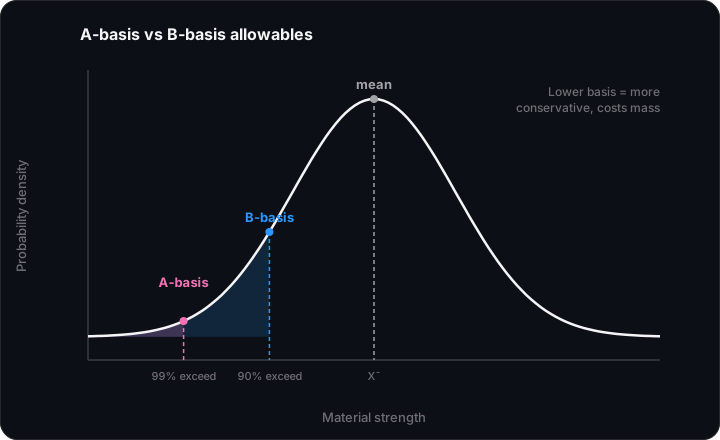
A-basis and B-basis are both statistical lower bounds on a population of test data at the same confidence. A-basis says at least 99% of the population should exceed it, 95% confidence, and you use it where one element failing is catastrophic because there’s no other path. B-basis says at least 90% exceeds it, same confidence, and you use it where load can redistribute if an element is weak. The gap between the two is set by the scatter and the sample size. For a normal distribution the value is X̄ − k·s, k being a one-sided tolerance factor that gets bigger as the sample shrinks and is larger for A than B. So a tight, well-populated dataset puts A and B close together, and a thin noisy one spreads them miles apart. A small composite qualification can punish you hard on A-basis purely because k is large for thirty-something specimens, which has nothing to do with the material being bad.
Both are lower bounds on the same data. A-basis sits further out on the tail, so it's lower, more conservative, and costs you mass. (With a finite sample the k-factor pushes the working value below the percentile itself.)
Picking A where B would do costs mass. Picking B where the structure really is single-load-path won’t survive a design review. And the basis follows from your damage-tolerance philosophy, it’s a structural decision, not a materials one, so sort the philosophy first.
Now the knockdowns, which is the part that actually bites. A room-temperature, dry, static, pristine-coupon allowable is the friendliest number you’ll ever touch, and real structure doesn’t live anywhere near there. Each effect below is a knockdown and they stack, and nobody ever lays them all out in one place which is a small ongoing irritation of mine:
Hot/wet. Elevated temperature plus absorbed moisture plasticises the matrix, so matrix-dominated properties (compression, shear, bearing) drop more than fibre-dominated tension. Cold can govern matrix tension and some metallic toughness instead. You qualify at the corners of the environmental envelope and carry the worst corner.
Open-hole and filled-hole. A fastener hole knocks unnotched strength down a lot. Open-hole compression is often the sizing allowable for a composite skin and can sit at a fraction of the unnotched laminate strength. Filled-hole gives some of it back.
Layup. Composite allowables are layup-specific. You can’t quote a UD lamina number and use it on a quasi-iso laminate, and at the extremes there’s sometimes an extra ply-percentage knockdown on top.
BVID/CAI. The cert basis usually wants the structure to carry load with barely-visible impact damage present, and compression-after-impact is frequently the design driver. Big knockdown, nothing to do with the static coupon.
Fatigue. Carries its own statistical reduction plus a scatter/life factor, separate conversation from static basis.
Stack hot/wet times notch times impact times scatter and the working compression allowable on a composite part lands at a small fraction of the pretty number on the datasheet. That small fraction is the honest one. There’s also a legitimate move people make where you’ve got a healthy B-basis dataset but a single-load-path detail, and rather than run a full A-basis qual the cert basis lets you take B down to an A-equivalent with a derivation factor, or pool data per an approved method. Fine, but that factor and that pooling assumption are now part of your substantiation and they go in the report. Don’t let a derived A-basis quietly pass itself off as a measured one.
So when someone quotes me a margin my first question is basically never “what’s the stress”. It’s which allowable, on what basis, at what environmental condition, with which knockdowns. If the answer is a bare number with no provenance the margin isn’t real yet, it’s arithmetic waiting for an allowable, and I’d rather find that out now than in front of an auditor.
esc
✦
Ask my CV
Ask me anything about Berkay's CV, projects and skills.
Türkçe de sorabilirsiniz.