Fatigue spectra get clipped at both ends and the clipping moves the answer. Omission, truncation, load interaction, and why the conservative direction isn't obvious.
By the time a fatigue spectrum lands on your desk it’s been through a chain of assumptions, mission mix, exceedance curves, gust and manoeuvre models, rainflow counting down to a list of cycles. Then two more decisions get made, usually for run-time reasons, and almost never written down: omission at the low end and truncation at the high end. They look like housekeeping. They can move the predicted life by a large factor.
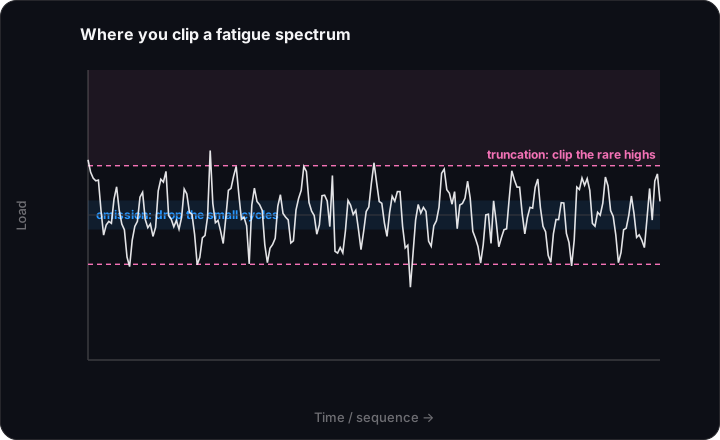
Two edits, both usually undocumented: omission drops the small cycles in the middle band, truncation caps the rare highs. (Drawn on the time trace for clarity; strictly, omission filters small ranges after cycle counting.)
Omission deletes the small cycles to shrink the spectrum and speed the run. Individually they might sit below the fatigue limit and do nothing. But clip too hard and you’ve binned cycles that do real damage in aggregate, especially near a notch where the local mean is up and there effectively isn’t a fatigue limit, so even small cycles keep accumulating. The honest way to set an omission level is to demonstrate it: drop the small cycles, recompute the damage, show the life moved by less than some agreed amount. Setting it by gut is how a “harmless” clip quietly eats your margin.
Truncation clips the rare high loads down to a ceiling, and this one is genuinely two-edged. Clip the real high loads out and, for crack growth, you can be unconservative, because you’ve removed the cycles doing most of the tearing (da/dN scales steeply with ΔK, m typically 2 to 4). But leave an artificially high load in, or cap at a level you’ll never actually see in service, and you over-credit retardation and flatter the life.
The reason it bites hardest in damage tolerance is load interaction. A single tensile overload drives a big plastic zone at the tip, and as the crack grows into it the compressive residuals retard growth, sometimes for thousands of cycles. The constant-amplitude Paris law, da/dN = C·(ΔK)^m, knows nothing about that, you need a retardation model (Wheeler, Willenborg, an Elber-style closure approach) to catch it. And it’s sequence-dependent, high-low retards, low-high can accelerate, and rainflow has already thrown the sequence away. So whether “conservative” is up or down depends on whether initiation or growth governs and on the model, which is why you can’t call it by reflex.
So: set omission by demonstration, be deliberate about the truncation level and say which way it errs for this region, treat retardation as a declared assumption (name the model or admit you’re ignoring it), and keep the un-clipped spectrum archived so the clip is reversible. Then write the levels into the report with the rationale, so future-you re-running it when the mission mix changes can tell whether a life change came from the structure or from where somebody drew the clip.
esc
✦
Ask my CV
Ask me anything about Berkay's CV, projects and skills.
Türkçe de sorabilirsiniz.